
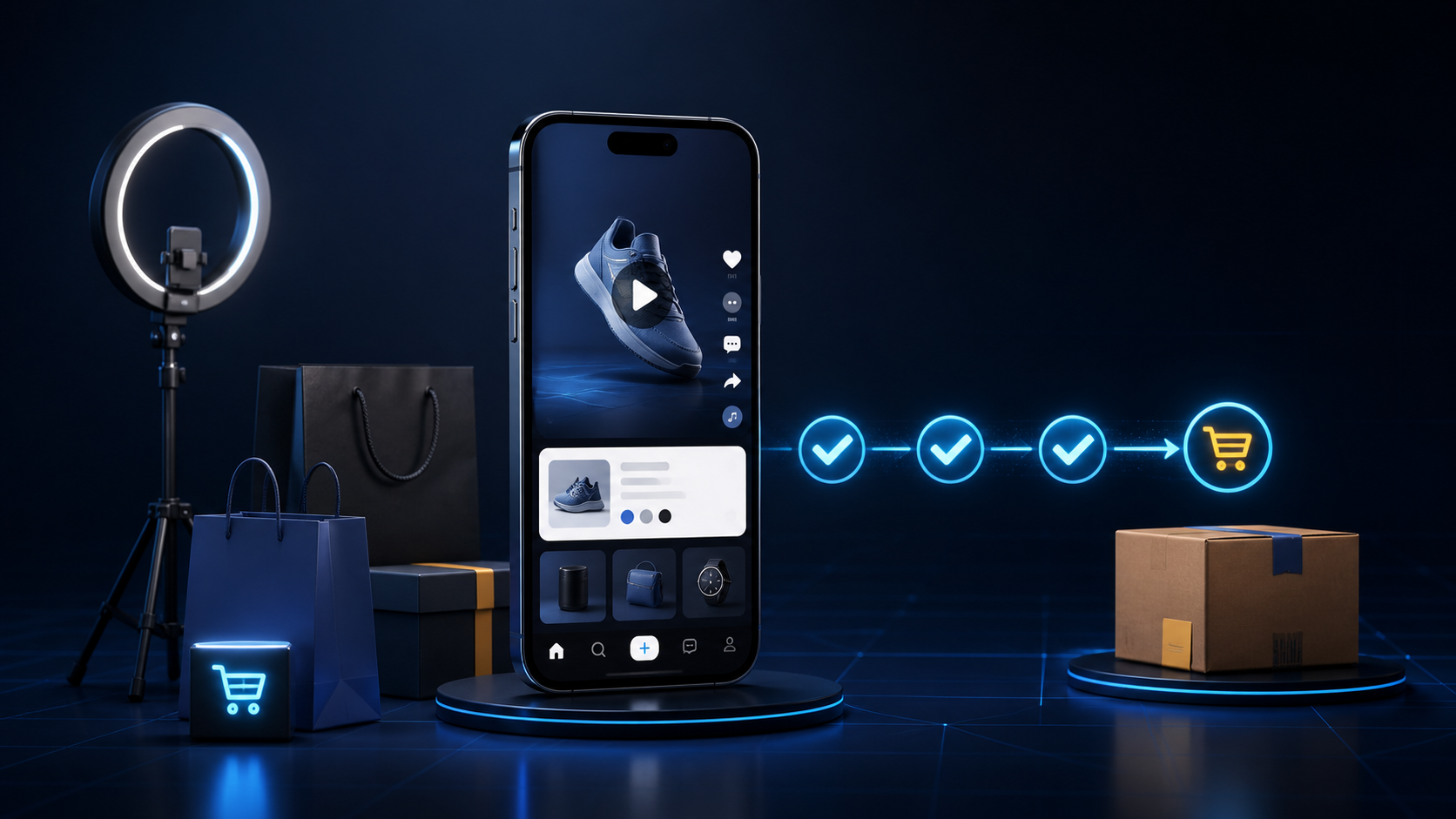
TikTok Shop can shorten the path from product discovery to checkout, but it also creates a second commerce operation. A seller needs more than a catalog upload. The offer has to work in short-form content, product data has to remain accurate, orders have to reach the existing fulfillment process, and returns and support need clear owners.
This checklist is for brands, manufacturers, and online stores evaluating TikTok Shop for September 2026. It is platform-independent: your main store might use a hosted platform, a custom stack, or a marketplace system.
Why social commerce deserves a test, not an assumption
DHL’s 2026 E-Commerce Trends Report surveyed 29,000 shoppers and 5,800 e-commerce businesses across 29 countries. It reports that 63% of businesses sell on social channels, while 45% of shoppers buy through social commerce. That gap matters. Presence alone does not prove that a channel will produce profitable demand for a specific catalog.
TikTok’s own Next 2026 trend report describes more intentional purchasing, with buyers looking for honest reviews, useful demonstrations, and evidence in comments before they commit. Treat that as a platform perspective, not independent proof. The practical conclusion is still useful: a launch needs credible product evidence, not only polished brand creative.
Step 1: confirm that the product fits the channel
Start with three to ten products, not the whole catalog. A strong pilot product usually has:
- a benefit that can be demonstrated in under a minute;
- enough margin to absorb creator fees, discounts, returns, and platform costs;
- reliable stock and a simple variant structure;
- a clear reason to buy now without an artificial countdown;
- customer questions that can be answered visibly;
- packaging and delivery that will not undermine the promise in the video.
Search the platform for the product problem, category, and alternatives. Record recurring questions, objections, review formats, and price expectations. Do not copy viral videos. Use the research to decide whether you can produce a more useful demonstration.
Define a stop rule before launch. For example, pause a product if contribution margin remains negative after a fixed number of completed orders, the return rate passes an agreed limit, or the team cannot keep stock and content synchronized.
Step 2: complete account and operational setup
Eligibility, documents, taxes, shipping options, and product rules differ by country and can change. Use the Seller Center for the market where the business is registered. The current US TikTok Shop setup guide shows the operational sequence: business verification, tax information, warehouse setup, products, and an official account.
Before submitting anything, assign an owner for:
- account verification and policy notices;
- catalog data and product approvals;
- inventory and price synchronization;
- order import and fulfillment;
- cancellations, refunds, and returns;
- creator relationships and disclosure requirements;
- customer messages and escalation;
- finance reconciliation and channel reporting.
Write the exception path as carefully as the happy path. Decide what happens when a paid order reaches an out-of-stock item, an address fails validation, tracking is late, a refund is approved on one system, or a product is removed for compliance review.
Step 3: build a small, trustworthy catalog
Each pilot listing should agree with the destination experience. Check:
- title, brand, category, identifiers, and variant names;
- current price, sale dates, currency, and tax treatment;
- stock by sellable variant;
- images and video claims;
- dimensions, materials, ingredients, or compatibility details;
- shipping promise and return policy;
- landing page availability if shoppers can leave the platform;
- prohibited-product and restricted-claim rules for the target market.
Create a daily catalog report that highlights price, stock, rejection, and mapping errors. A silent sync is not a healthy sync. Someone should be able to answer which system is authoritative for price, inventory, order state, and refunds.
Step 4: prepare evidence-led content
Build a content backlog before the shop goes live. For each pilot product, prepare:
- a plain demonstration of the core benefit;
- a comparison that states the decision criteria fairly;
- an answer to the most common objection;
- a setup, sizing, care, or compatibility guide;
- a customer-review format with appropriate permission and disclosure;
- a behind-the-scenes explanation of materials, production, or testing.
The goal is not to make every post look like an advertisement. It is to help a viewer decide. Show limitations when they matter. Keep claims consistent with the listing and evidence available to the business.
Creators need the same source of truth as the support team. Give them approved product facts, prohibited claims, disclosure requirements, current offers, stock limitations, and a route for unanswered questions. Do not give them a rigid script that removes their own judgment and voice.
Step 5: test the complete order loop
Place test orders for every pilot variant and at least one failure case. Verify:
- the displayed price and final charged amount;
- discounts and shipping fees;
- inventory reservation and release;
- order data received by the warehouse or order-management system;
- picking, packing, carrier handoff, and tracking updates;
- cancellation before fulfillment;
- partial and full refunds;
- a return from request to inventory disposition;
- support visibility across all systems;
- finance settlement and fee reconciliation.
Save evidence from each step and name the owner of each defect. A catalog that looks correct is not ready until the order, support, and accounting paths also work.
Step 6: measure profit and learning
Views and gross merchandise value can hide an unhealthy launch. Use a compact scorecard:
- qualified product-page visits;
- add-to-cart and completed-order rate;
- contribution margin after discounts, platform costs, creator costs, fulfillment, and returns;
- cancellation and return rate by product and content source;
- support contacts per completed order;
- stock or price incidents;
- creator content that continues to convert after the first spike;
- repeat purchase or direct-site engagement where measurement and consent allow it.
Compare cohorts, not isolated viral posts. A lower-volume product with stable margin and fewer support problems may be a better scale candidate than a high-volume product driven by deep discounts.
A four-week launch plan
Week 1: demand and economics
Select the pilot products, review platform demand, calculate contribution margin, define the customer promise, and agree on stop rules.
Week 2: catalog and operations
Complete verification, map catalog fields, connect inventory and orders, document exceptions, and assign operational ownership.
Week 3: content and end-to-end testing
Produce the first content set, onboard a small creator group if relevant, place test orders, and fix catalog, fulfillment, return, and reporting defects.
Week 4: controlled release
Launch to a limited assortment and budget. Review the scorecard daily for operational failures and weekly for commercial decisions. Expand only after the first products remain accurate and profitable.
The launch decision
Launch when the business can show four things: real audience interest, a product that survives channel economics, a reliable order-and-return loop, and enough credible content to keep learning. Delay when success depends on permanent discounts, unverified claims, manual stock fixes, or one creator hit.
TikTok Shop should be a measured channel connected to the rest of the business, not a separate storefront that nobody can reconcile.
Need help connecting social commerce to your stack?
MerchWeave builds e-commerce systems, product data flows, and custom integrations. Contact us to scope a focused social-commerce launch audit.
Sources and update note
- DHL: 2026 E-Commerce Trends Report
- TikTok for Business: Next 2026 Trend Report
- TikTok Shop Seller Center: How to set up your TikTok Shop
The platform guidance and survey figures above were reviewed on August 18, 2026. Confirm current eligibility, fees, policies, tax obligations, and shipping options for the seller’s market before launch.